Water that stops all at once and water that has gone weak over months usually have different causes. Sudden loss points to something on the street side of the house, such as a closed valve or a frozen pipe. A slow decline points to the pipe itself. This guide covers both, then explains how to find and test the main shut-off valve, which every homeowner should be able to operate.
Why did the water just turn off?
Start by narrowing it down. These four questions rule out most causes in a few minutes.
- **Is it every tap or only one?** If one tap is dead and the rest run, the fault is at that fixture or its supply line. If every tap is dead, the cause is at the main or beyond it.
- **Hot and cold, or only hot?** If only the hot side has stopped, look at the water heater and the valve on its cold inlet before anything else.
- **Do the neighbours have water?** If the whole street is dry, the cause is almost certainly a break or planned work on the municipal main. Check with the City before calling a plumber.
- **Has anyone touched a valve?** A main valve closed for a repair and never reopened is more common than people expect, and so is a partly closed one.
If the street has water and your house does not, and no valve has been touched, think about the season.
Could the pipe be frozen?
Environment Canada's 1981 to 2010 climate normals for the Welland station give about 139 days a year with a minimum at or below 0 °C and about 31 days a year below −10 °C, with a January mean daily minimum of about −8.3 °C. That cold reaches pipes that run through outside walls, crawl spaces, unheated porches and garages, and the stretch of service line just inside a basement wall.
Signs of a frozen pipe:
- The water stopped on a cold night or morning, often after a run of colder days.
- Some taps work and others, usually on an outside wall, do not.
- A section of pipe is frosted, or is noticeably colder than the rest.
What to do:
- Open the affected tap so meltwater has somewhere to go.
- Warm the pipe slowly with a hair dryer or warm air from a space heater kept well clear of anything that can burn. Never use an open flame.
- Open cabinet doors under sinks on outside walls so room heat reaches the pipe.
- Know where the main shut-off is before the pipe thaws. Ice expands, and a split that holds while frozen will spray when it melts.
If you find a split, or water appears as the pipe thaws, close the main and call an emergency plumber.
Why is my water pressure low?
Pressure that drops slowly over months or years is a different problem. Again, narrow it down.
### One fixture only
The cause is almost always local: a clogged aerator on a faucet, a scaled shower head or a worn cartridge inside the valve. Unscrew the aerator and look at the screen. If it is packed with grit or white scale, clean or replace it and test again.
### Hot side only
The cause is usually the water heater or the piping right next to it, because scale builds up inside tanks and in the fittings around them. Niagara Region owns and operates the Welland Water Treatment Plant, which serves Welland, Pelham and portions of Thorold. The Region's published hardness for that plant was 129 mg/L, measured Oct. 7, 2026. Hardness is the dissolved calcium and magnesium in the water, and that level is enough to leave scale in a heater over time, especially one set hot. A partly closed inlet valve on the heater gives the same symptom, so check that first.
### Whole house, hot and cold
The cause is at the main or in the pipe that feeds the house. The usual suspects:
- **A main valve that is not fully open.** Check it first, since it costs nothing.
- **A leak.** Close every tap and watch the water meter. If the dial still moves, water is going somewhere.
- **Corroded pipe.** Galvanized steel pipe rusts from the inside. The rust narrows the bore, the open space inside the pipe, until less water can pass, while the outside still looks fine.
- **An undersized or failing service line.** The service line runs from the City's shut-off at the property line into your basement. An old one can be both narrow and corroded.
What does the age of a Welland house tell you?
The pipe a house was built with predicts most low-pressure calls. In Welland there are three main eras.
- **French Town, built before 1945.** The streets around Empire, Burgar, Cozy, Division, Duncan and Welland streets went up during the city's early industrial boom. Houses of that age typically have a lead or galvanized steel water service, and low pressure from corroded pipe is one of the usual calls.
- **The wartime streets of the 1940s.** Dunkirk Road, Dieppe Street, Corvette Street, Calais Street and McNaughton Road were built for wartime workers. These small houses typically have galvanized steel or early copper water lines, and corroded supply pipe is a common problem.
- **The 1960s and 1970s subdivisions.** Karen Crescent and Aquador Drive, by Fitch Street, typically have copper water lines. Copper does not close up the way galvanized does, but ageing copper develops pinhole leaks, and a small hidden leak can show up as pressure loss.
To check what you have, look at the pipe where it comes through the basement wall, before the meter:
- Lead is dull grey and soft. A coin scratches it shiny, and a magnet will not stick.
- Galvanized steel is grey with threaded joints, and a magnet sticks.
- Copper is reddish-brown, with soldered joints.
Our guide to Kitec and galvanized pipe covers telling pipe types apart, and when replacing them makes sense, in more detail.
Is there help with replacing a lead service?
Yes. In partnership with Niagara Region, the City of Welland offers a grant to property owners who have a lead water service pipe, or who share a water service with a neighbour. The grant goes toward replacing the pipe with new copper. The application must be approved before work begins, and work started first may not qualify. Apply, wait for approval, then book the replacement.
For reference, Ontario's drinking water quality standard for lead is a maximum of 0.010 mg/L under Ontario Regulation 169/03. A new copper service fixes the pressure problem and the lead problem together.
How do you find your main water shut-off valve?
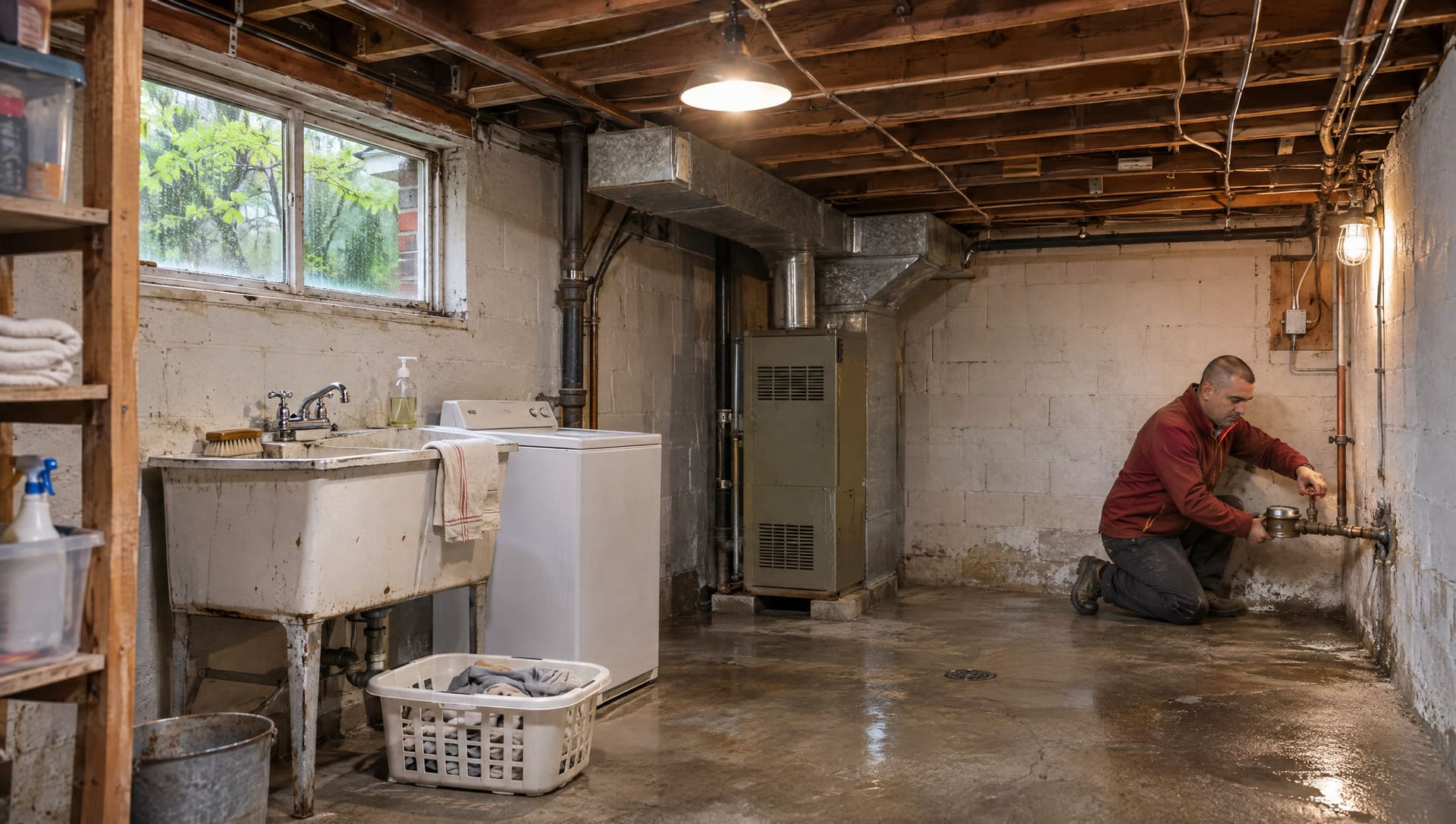
In most Welland houses the main valve is in the basement, where the water service comes through the foundation wall, usually the wall facing the street. Look for the water meter. The main valve is on the pipe beside it, normally on the street side. Some houses have a second valve on the house side of the meter.
There are two common types:
- **Gate valve:** a round wheel handle. It closes by turning clockwise, several full turns. Older houses usually have these.
- **Ball valve:** a lever handle. It closes with a quarter turn. When the lever lines up with the pipe the valve is open; when it sits across the pipe it is closed.
How do you test the main shut-off?
Test it on a calm day, not during a leak.
- Open a cold tap on the lowest floor and let it run.
- Close the main: clockwise until it stops for a gate valve, a quarter turn for a ball valve.
- Watch the tap. Within a short while the flow should stop completely.
- Reopen the valve fully, then back a gate valve off about a quarter turn so it does not seize in the open position.
- Check the valve stem for drips over the next hour.
What the result means:
- Flow stops and there are no drips: the valve works. Show everyone in the house where it is.
- Flow slows but never stops: the gate inside is worn or scaled and will not hold in an emergency.
- The handle will not turn: do not force it with a wrench. Old gate valves can snap at the stem, and then the only shut-off left is the City's valve at the property line.
- Water drips from the stem afterwards: the packing around the stem needs tightening or the valve needs replacing.
A main valve that fails any of these tests is worth replacing before you need it. Many owners change a seized gate valve for a ball valve, which is harder to seize and closes with a quarter turn. Replacing the main needs the City to shut off the supply at the property line. Ask for a written price first, and expect the plumber to look at the condition of the service pipe while it is exposed.
What do you decide?
If the water stopped suddenly, check the valves, then the neighbours, then for frozen pipe. If the pressure has dropped over time, work out whether it is one fixture, the hot side or the whole house. In an older Welland house, assume the pipe may be the cause until a test says otherwise. Then decide whether to repair a fitting, replace a valve, or apply for the lead-service grant and replace the whole service.
For a pressure test, a seized valve or an ageing service line, see plumbing repairs at Welland Plumbing and Drain.