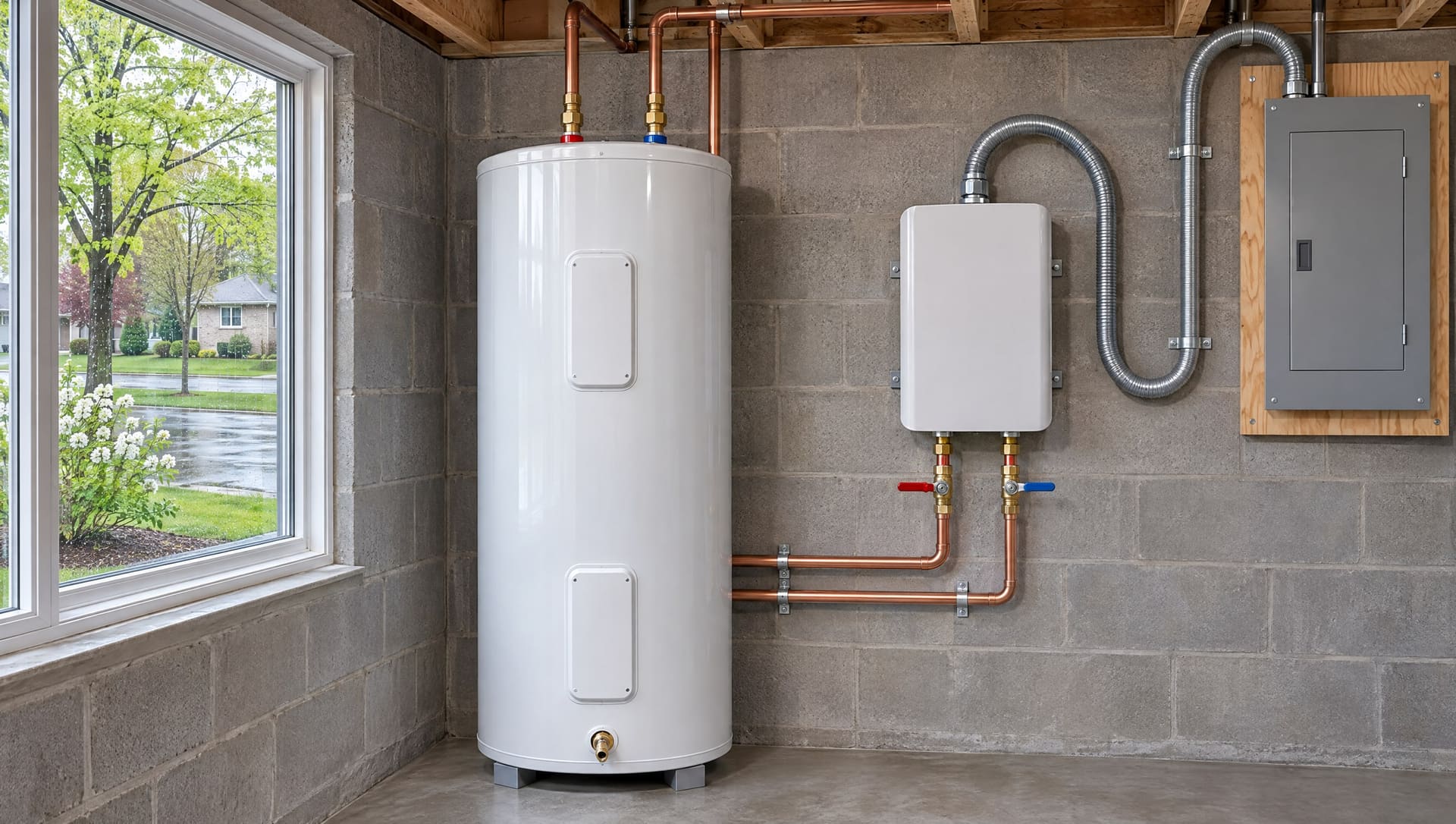
Three kinds of pipe come up again and again when people buy older houses: Kitec, galvanized steel and lead. They fail in different ways and for different reasons. Before you decide anything, find out which one you actually have and test how it is performing.
Kitec, galvanized and lead: how do you tell what your house has?
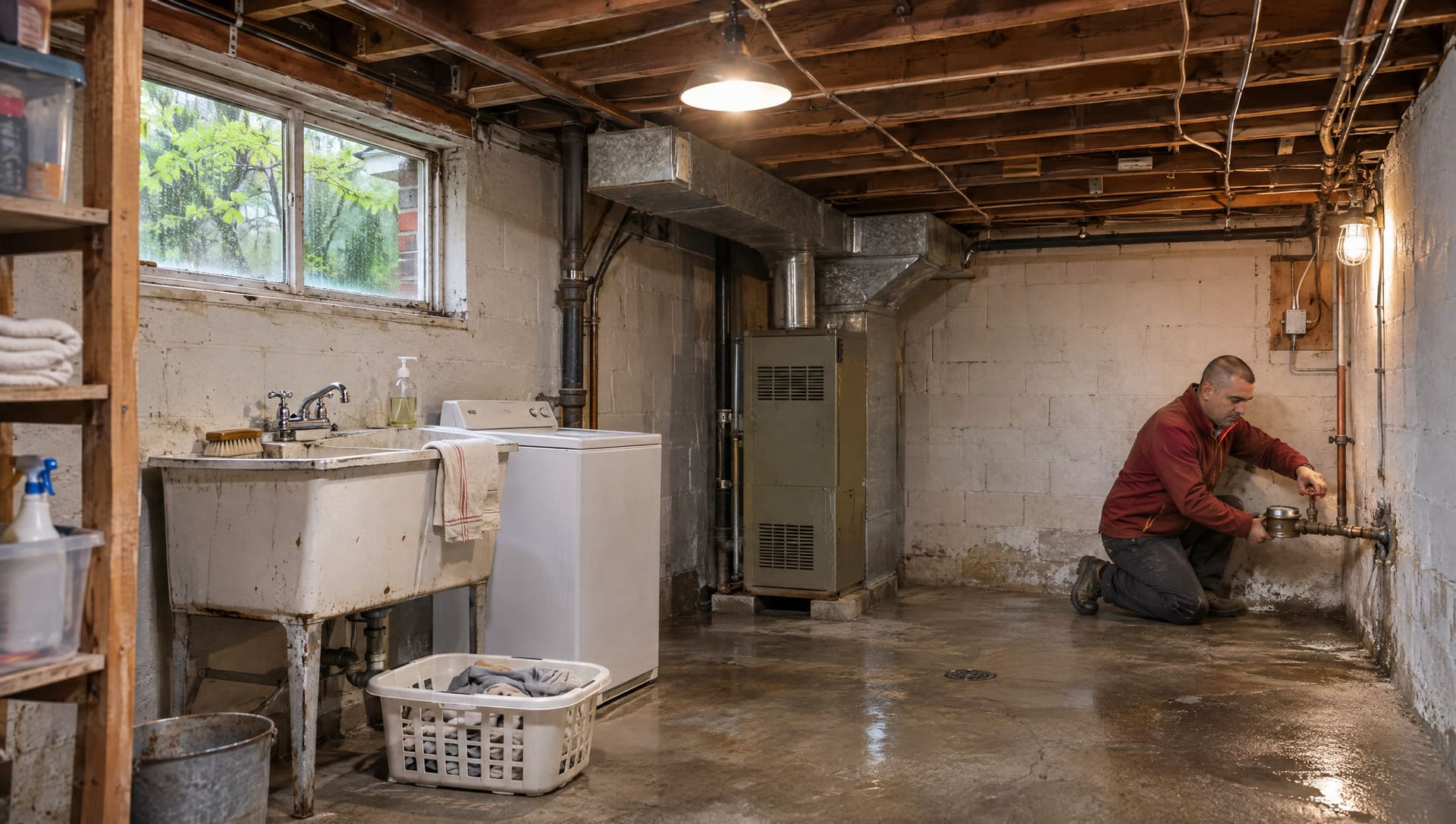
Start where the water service enters the basement, usually on the front wall, then follow the pipe to the meter, the main shut-off and the water heater. Bring a fridge magnet and a coin.
- **Lead.** Dull grey and soft. Scratch it gently with a coin and the scratch shows bright silver. A magnet will not stick. The joints are often swollen, rounded bulbs instead of threaded or soldered fittings. Lead is almost always the service line from the street, not the pipe inside the house.
- **Galvanized steel.** This is steel pipe coated in zinc. It is grey, hard and has threaded joints. A magnet sticks to it. Look for rust staining at the threads.
- **Copper.** Brown or the colour of a penny, turning green where it has oxidized. Joints are soldered. A magnet will not stick.
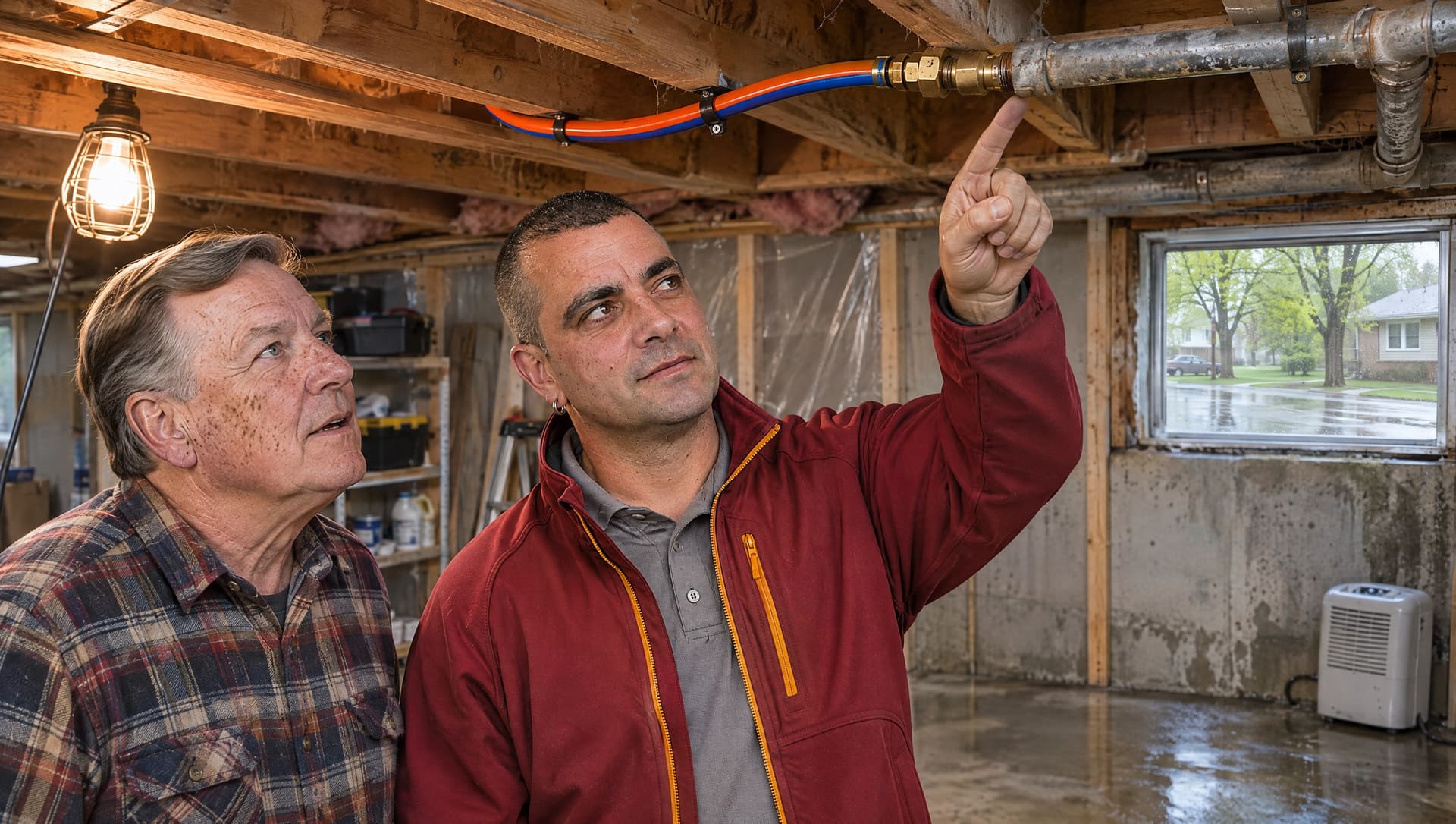
- **Kitec.** This is a flexible plastic pipe with a thin aluminium layer inside, joined with brass fittings. It is usually orange for hot water and blue for cold, though it was also made in other colours. The name is often printed along the pipe. The water heater connections and the lines under sinks are the easiest places to check.
A house can have more than one of these. A lead service might feed galvanized pipe inside, or a renovation might have spliced copper into the original steel. Check every pipe you can see, not just the first one.
Which Welland houses are likely to have which pipe?
The house's age is a good first guide. Treat it as a guess until someone looks at the pipe.
- **French Town, before 1945.** On Empire, Burgar, Cozy, Division and Duncan streets, houses from Welland's early industrial years usually have a lead or galvanized water service, cast iron drain stacks and a clay tile sewer. Low pressure caused by corroded pipe is a common complaint.
- **The wartime streets, 1940s.** On Dunkirk Road, Dieppe Street, Corvette Street, Calais Street and McNaughton Road, the small houses built for war workers usually have galvanized steel or early copper supply lines. Corroded supply pipe is one of the most common faults there.
- **Karen Crescent, Aquador Drive and the Fitch Street area, 1960s to 1970s.** These houses usually have copper water lines. Here the age problem is pinhole leaks in old copper, not galvanized steel.
Kitec doesn't belong to any one of these eras. It turns up wherever a house was built or re-plumbed while the product was on the market, including older houses where a renovation replaced part of the original pipe.
Is Kitec plumbing still used?
No. It is no longer made and plumbers no longer install it. What is still out there is the pipe already in walls and ceilings.
The problem is mostly the fittings, not the plastic. The brass fittings can lose zinc from the alloy, a process called dezincification. That leaves the metal porous and weak. Early signs are a white or greenish crust on a fitting, or a weep of water at a joint. Hot water lines and lines running at high pressure are under the most stress. A fitting can fail without warning, and because the pipe is often hidden, the first sign may be a stain on a ceiling.
Should you replace Kitec plumbing?
In most cases, yes. What you need to decide is when.
Look at the fittings you can see. If any are crusted, damp or discoloured, replace them now and plan to re-pipe the house. If they look clean, you have time to plan the job around a renovation or a season that suits you. Clean fittings don't prove the hidden ones are sound, though.
Before you decide, check:
- **Static pressure.** A gauge on a hose bib or laundry tap reads the pressure with nothing running. High pressure puts more load on every fitting. If there is a pressure-reducing valve, check that it is working.
- **Fitting condition** at the water heater, under sinks and at the manifold, if there is one.
- **Your insurer's position.** Some insurers ask about Kitec and change coverage when it is present. Ask yours directly and get the answer in writing.
When the house is re-piped, the replacement is usually PEX (a cross-linked plastic pipe) or copper. Both are sound. The choice depends on access, the layout and what you plan to open up anyway.
Should you replace galvanized pipe?
Galvanized steel corrodes from the inside. Rust builds up on the inner wall until the opening is a fraction of its original size. The outside can look fine while the bore is nearly closed. Steel threads are thinner than the pipe wall, so leaks tend to start at the joints.
Judge it by flow. With one fixture running, open a second: if the flow at the first drops sharply, the supply is restricted. A pressure reading at the main, compared with one at an upstairs tap, shows where the loss is. Brown water after the house has sat unused points the same way.
If pressure and flow are acceptable and the joints are dry, you can leave galvanized in place and watch it. If flow is poor, or the joints are wet or rusted, replacing it is the lasting fix. Cleaning the fixtures only treats the symptom. Replacing a short section often moves the restriction to the next stretch of old pipe, so many owners re-pipe a whole floor or the whole house at once.
What about a lead service line?
A lead service line affects water quality as well as pressure. Ontario's drinking water standard for lead is a maximum of 0.010 mg/L (10 micrograms per litre), under Ontario Regulation 169/03 of the Safe Drinking Water Act, 2002. A lab test of a water sample tells you where your water stands against that limit.
The City of Welland, working with Niagara Region, offers a grant to property owners who have a lead water service, or who share a service with a neighbour. It goes toward replacing the pipe with new copper, up to a standard maximum per property. The application must be approved before work begins. Work done before approval doesn't qualify, so apply first and book the work second.
Replacing a service means digging. In Ontario a locate must be requested through Ontario Dig Authority before any digging. Public locates don't mark private lines such as the house's own sewer, so those have to be found separately. New plumbing and changes to plumbing generally need a building permit. The City's building department confirms whether a particular job does.
Is Kitec or galvanized pipe a deal breaker when buying a house?
Usually not, provided you know what you are buying and price it into the decision. It becomes a problem when you only find out after closing.
- **Identify it before you firm up.** Ask your home inspector to note the pipe material at the service entrance, the water heater and under the sinks. If you see orange and blue pipe or a magnet sticks to the supply line, get a plumber to look.
- **Get the replacement priced in writing.** A written scope tells you whether this is one short run or a whole-house re-pipe, and gives you a real number to bring to the negotiation.
- **Call your insurer before closing.** Find out whether Kitec, galvanized or a lead service changes your coverage or premium. Some buyers make the deal conditional on getting acceptable insurance.
- **Check the drains while you are at it.** Houses old enough to have galvanized or lead supply pipe often have cast iron stacks and a clay sewer lateral, the private pipe running from the house to the street sewer. A camera inspection of the lateral is worth doing on the same visit. See sewer repair and backwater valves.
A house with Kitec or galvanized pipe that has been priced, negotiated and scheduled for replacement is a known cost. A house with pipe nobody has identified is the bigger risk.
Who should do the work?
Plumbing is a compulsory trade in Ontario. Work is performed by licensed plumbers (306A Certificate of Qualification). On a re-pipe, ask that the scope covers which runs are replaced, how walls and ceilings will be opened and closed, whether a permit is required and who arranges the inspection.
To have the pipe in your Welland house identified, tested and priced, see plumbing repairs.