A water heater does one job: it raises cold incoming water to a usable temperature. A tank heater does it ahead of time and stores the result. A tankless heater does it on demand, as the water passes through. Either type can be electric or gas. The right choice depends on how much hot water you use at once, what your electrical panel or gas line can supply, and what the water does to the heater over time.
What is a tank heater, and what is tankless?
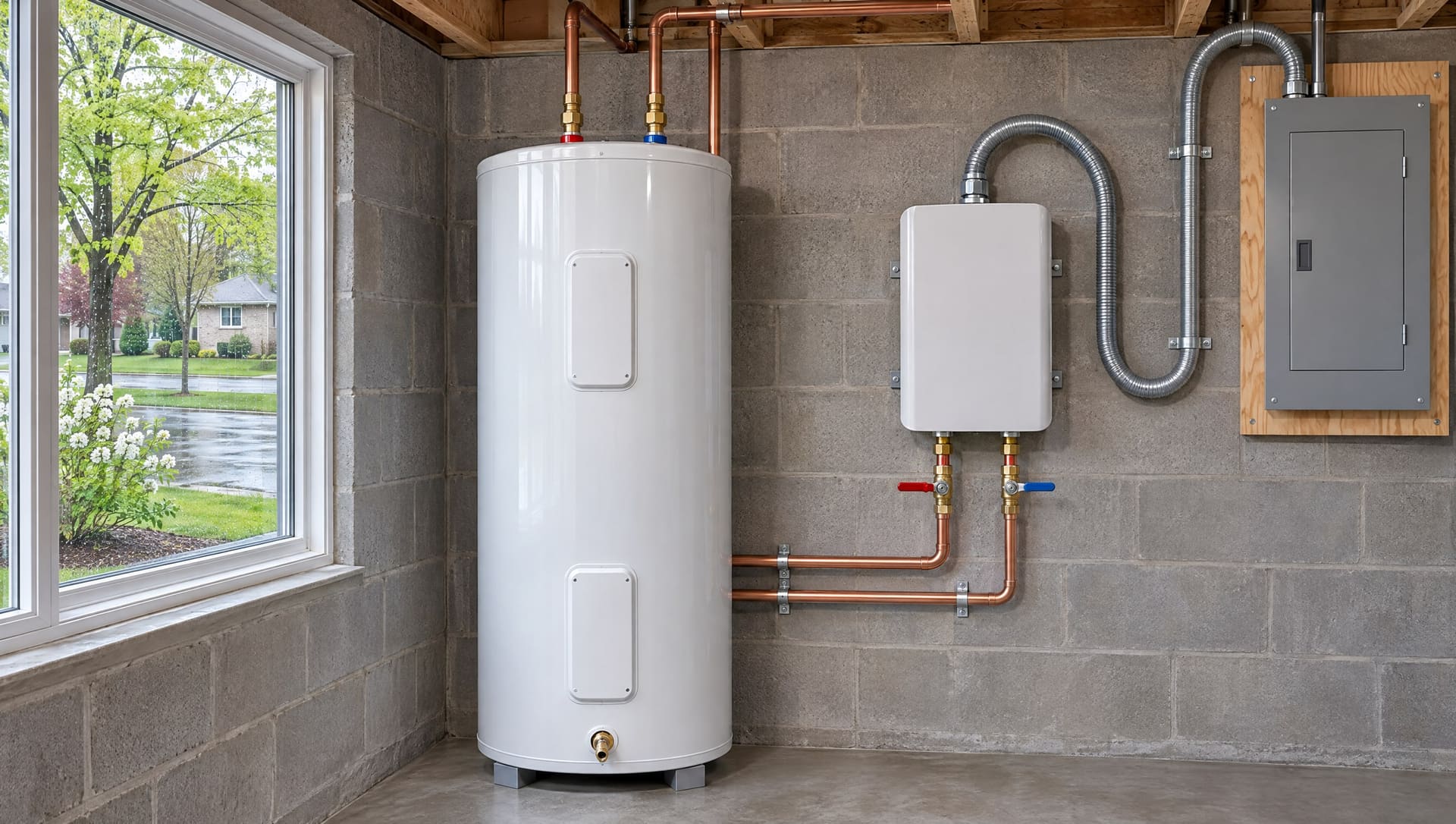
A tank heater holds a fixed volume of water and keeps it hot. An electric tank uses one or two immersion elements, which are metal rods that heat the water directly. A gas tank uses a burner under the tank and a flue to vent the exhaust. When you run a shower, hot water leaves the top and cold water enters at the bottom. Once the stored hot water is used, you wait for the tank to recover.
A tankless heater, also called on-demand, has no storage. A flow sensor detects water moving and switches on the heating elements or the burner. Hot water lasts as long as the tap runs, but only at the flow rate the heater can keep up with.
What is the downside of an electric tankless water heater?
There are four, and they matter more in an older Welland house than in a new one.
- Electrical load. Heating water instantly takes a very large amount of power all at once. A whole-house electric tankless unit typically needs several dedicated high-amperage circuits. Many houses do not have the spare capacity in the panel, and some need a service upgrade from the utility before the heater can be installed. That cost often exceeds the cost of the heater. The small houses on Dunkirk Road, Dieppe Street and Calais Street were built in the 1940s for wartime workers, and the electrical service in houses of that age has often been upgraded only partly. Check the panel before anything else.
- Winter flow. A tankless heater's output is limited by temperature rise: the number of degrees it has to add to the incoming water. Welland's water comes from Lake Erie by way of the Welland Canal and the Welland Recreational Canal, and the incoming water is coldest in winter. Environment Canada's 1981 to 2010 normals for the Welland station give about 139 days a year with a minimum at or below 0 °C. On those days the same unit delivers less hot water per minute than it does in summer. A heater that runs two showers in July may run one in February.
- Scale. Niagara Region's published hardness for the Welland Water Treatment Plant was 129 mg/L, measured Oct. 7, 2026. Hardness is the dissolved calcium and magnesium in the water. When water is heated, part of it comes out as scale, a hard mineral crust. In a tankless unit the water passes through narrow passages over hot elements, so scale builds where it does the most harm. It lowers output and can trip the unit's high-temperature cut-off. Tankless heaters on this water need periodic descaling, which means flushing a mild acid solution through the unit with isolation valves fitted for the purpose.
- Minimum flow. The heater turns on only above a set flow rate. A hot tap barely opened to rinse a cup may get no heat at all, and you get cold-water slugs when taps open and close in quick succession.
An electric tank has none of these limits in the same form. It draws far less power because it heats slowly, it has no minimum flow, and scale settles at the bottom of the tank, where flushing removes much of it. Its limits are the stored volume, the recovery time and standby loss, which is the heat lost through the tank walls while the water waits.
Which electric hot water heater is the best?
No brand is best for every house. Judge the heater by what it has to do in yours.
- For an electric tank, compare the first-hour rating. This is the amount of hot water the heater can deliver in one hour starting full. It is printed on the label and is a better guide than the tank volume alone. Match it to your busiest hour, usually the morning showers.
- Look at the anode rod. The anode is a sacrificial metal rod that corrodes so the steel tank does not. A tank whose anode can be reached and replaced will last longer. On hard water, check it more often.
- Consider a heat pump water heater. This is an electric tank that moves heat from the surrounding air into the water instead of making all of it with elements. It uses considerably less electricity than a standard electric tank. It needs room around it, it cools the space it sits in, and it is louder. An unfinished basement usually suits it.
- For electric tankless, start with the panel. Size the unit to the flow you need at your coldest incoming water temperature, then confirm the electrical service can carry it. If it cannot, the choice is made for you.
- Read the manufacturer warranty. Tank warranties are usually tied to the tank lining, and some exclude damage from scale or lack of maintenance. Know what upkeep the warranty expects before you buy.
Tank or tankless: how do you decide?
Answer these in order.
- How many fixtures run hot at once? Count the showers, the dishwasher and the washer that overlap at your busiest time. A tankless heater must cover all of them at once. A tank must hold enough for that hour.
- What fuel do you have? If the house has gas, a gas tankless unit avoids the electrical problem. It needs a gas line large enough for its burner and its own venting, usually through an outside wall. In Ontario, gas water heaters must be installed and serviced by a registered contractor under Ontario Regulation 212/01 (Gaseous Fuels). Gas work is performed by TSSA-certified gas technicians.
- What can the panel carry? If electric is the only option and the panel is near its limit, an electric tank or a heat pump tank is usually the practical answer.
- Will you maintain it? On Welland's water a tankless unit needs descaling on a schedule. A tank needs flushing and an anode check. If upkeep will not happen, choose the heater that tolerates neglect better, which is usually the tank.
- Where does it go? A tankless unit hangs on a wall and frees floor space. A tank needs floor space and a drain pan or floor drain nearby. In the French Town houses near Empire and Burgar streets, the basement floor drain is often tied straight to the sewer. That drain is the one that backs up in heavy rain, so do not rely on it as the only route for a leaking tank.
What about the 49 °C limit at the tub?
Ontario's Building Code (Part 7, Article 7.2.10.7., Water Temperature Control) limits the water discharging from a shower head or into a bathtub to 49 °C. The limit applies at the fixture, not the heater. A tank is often set hotter to stretch the stored supply. In that case a mixing valve at the tank, or temperature-limiting valves at the fixtures, brings the water down before it reaches the tub. A tankless heater can be set to deliver close to the target directly, but the fixture limit still applies. When a heater is replaced, check that the tub and shower temperature is measured at the tap, not just set on the dial.
Does replacing a water heater need a permit?
Under the Building Code Act, 1992, installing, extending or materially altering plumbing generally needs a building permit. Whether a straight swap does is a question for the City of Welland's building department. Changing fuel, moving the heater or adding new piping and venting is more likely to need one. Ask before the work is booked.
What should you decide first?
Find your busiest hour, look at your panel and your gas line, and plan for the hardness of the water. Those three readings settle most decisions before you open a brochure.
To have your current heater tested and a replacement sized to your house, see water heaters.